martes, 15 de diciembre de 2015

Plurals


PLURALS IN HINDI 

The endings for plural nouns vary depending on the gender of that noun. 


Let’s start with masculine nouns. 

Masculine nouns ending in –aa - change to –e –
बेटा betaa son बेटे bete sons
लड़का larkaa boy लड़के larke boys

All other masculine nouns –those that end in consonants or other vowels – remain the same plural:
दोस्त Dost (friend/friends)  शहर shahar (city/cities)

Some masculine nouns ending in – are actually Sanskrit loanwords, and they remain the same in plural. Of course, you won’t recognize these at first, but you’ll get a better sense of them as you learn more Hindi. Also nouns ending in – and indicating familial relations remain the same in plural. राजा raajaa (king/kings) चाचा chaachaa (uncle/uncles)

Now let’s take a look at feminine nouns.

 Feminine nouns ending in – ee and I change to –इयाँ iyaan in the plural. Keep in mind that the long – gets shortened to – in the plural, and don’t forget that the ending is nasal.
बेटी बेटियाँ (daughter- daughters)
नदी नदियाँ  (river- rivers)

There are a just few feminine nouns that end in –या –yaa. The –या of this nouns is nasalized in the plural becoming –याँ –yaan.
चिड़िया chiriyaa bird चिड़ियाँ chiriyaan birds

All the other fem. Nouns take the additional –एँ –en in the plural.
किताब Kitaab book  किताबें kitaaben books
भाषा Bhaashaa language भाषाएँ bhaashaaen languages

Just note that if a feminine noun ends in a long oo, it is shortened in the plural.

वधू Vadhoo bride वधुएँ vadhuen brides


lunes, 14 de diciembre de 2015

Hindi Verbs & Nouns


Hindi verbs are inflected with respect to


  •  gender of the subject (masculine, feminine),
  •  number of the subject (singular, plural),
  •  tense (present, past, future),
  •  action (perfect, imperfect, continuous),
  •  degree of respect (intimate, familiar, respect).


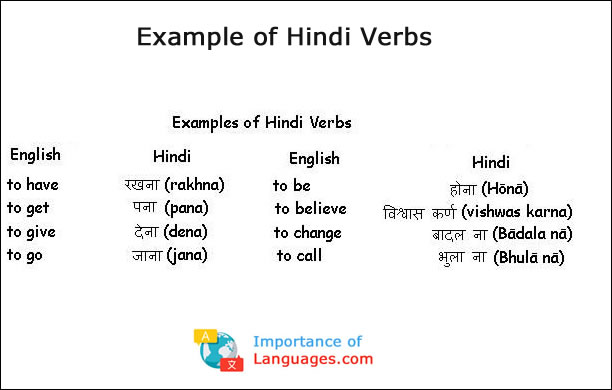
Verbs are referred to in their infinitive noun form which ends in na.
Examples:

bolna to speak
likhna to write
lena to take
ana to come

The stem of a verb is the infinitive form without the “ na” ending.
Examples:
bol , likh, le , a


*******

Nouns

Gender (Ling ) / Number (Vachan )

Hindi has two genders, masculine (nouns ending in a) and feminine
(nouns ending in I ) but there are exceptions.
As for the number, we distinguish between singular (Ekvachan) and plural (Bahuvachan)

Case

There are two cases in Hindi, direct and indirect.
The indirect case is used when the noun is followed by a post-position, otherwise the
direct case is used.
Examples:
Masculine nouns on -a: larka = boy
Singular larka (direct) larke (indirect)
Plural larke(direct) larkon (indirect)
Feminine nouns on -i: larki = girl
Singular larki (direct) larki (indirect)
Plural larkiyan (direct) larkiyon (indirect)

Hindi हिन्दी Introduction and Syntax


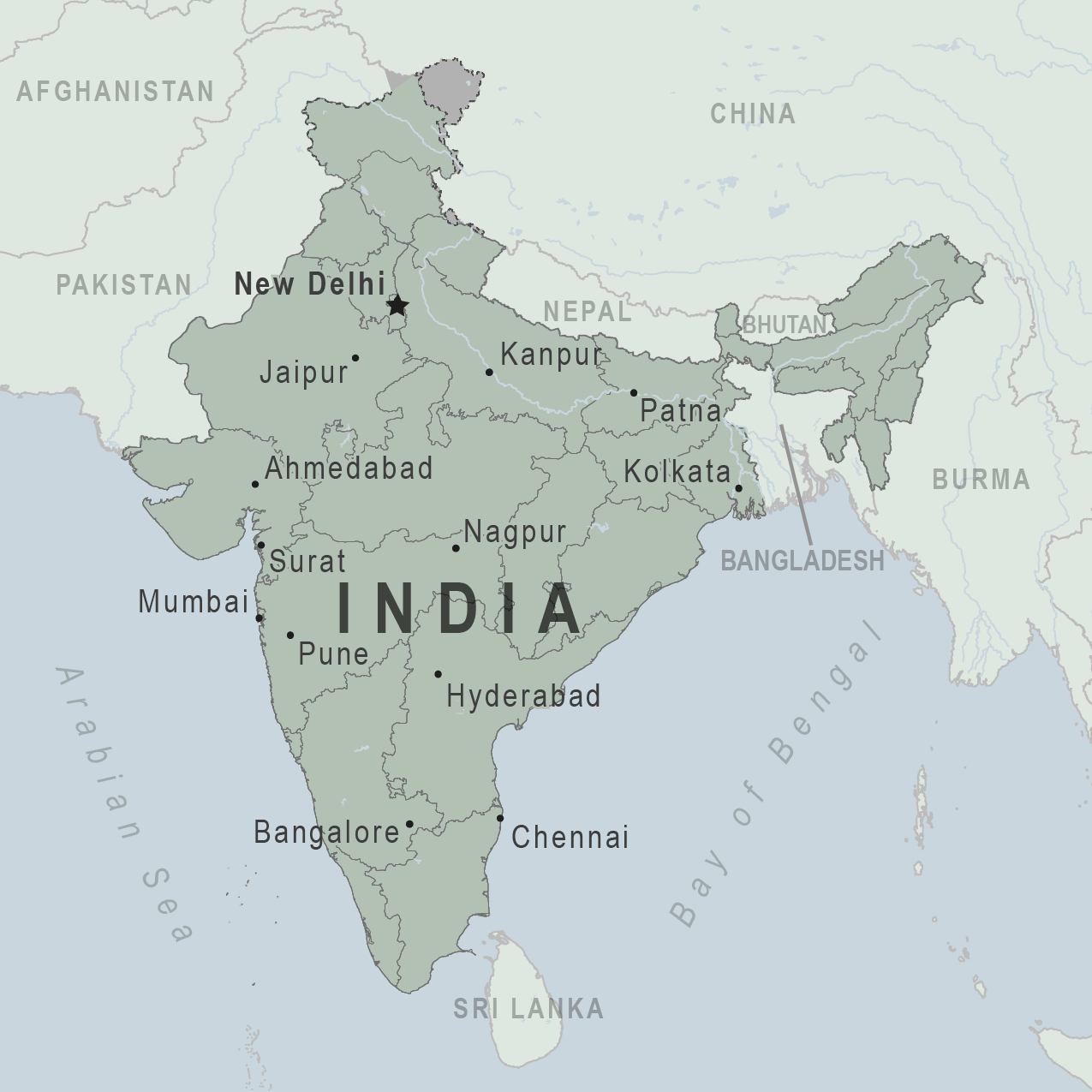
Hindi the national language of India is an Indo-Aryan language with over 500 million speakers. It is one of the official languages of India and is the main language used in the northern states of Rajasthan, Delhi, Haryana, Uttarakhand, Uttar Pradesh, Madhya Pradesh, Chhattisgarh, Himachal Pradesh, Jharkhand and Bihar, and is spoken in much of north and central India alongside other languages such as Punjabi, Gujarati, Marathi or Bengali. In other parts of India, as well as in Nepal, Bangladesh and Pakistan, Hindi is understood. In Fiji people of Indian origin speak Hindi, and in some areas the Fijian people also speak it.

Hindi is a phonetic language. Hindi words are pronounced exactly as they are written. You don't have to memorise the correct spelling of a word. All consonants have an 'a' sound inherent in them. To write the English word 'come' in Devanagari script all you do is assemble the two consonants क (Ka) and म (Ma) by keeping them together and joining them with the horizontal head stroke as shown below 

कम (Kam)
Similarly to write the Hindi word 'kamal' (lotus) you will simply add ल (La) to the end of the
above word and join all three letters together with the horizontal line:

कमल (Kamal)


Syntax


Hindi uses a different word order than English. The main differences are that verbs are
placed at the end of the sentence (like in German) and that Hindi (like other Indian
languages) uses postpositions instead of prepositions.
Postpositions are like prepositions except that they are written after the noun.
Example:

Normal sentences
English: Subject Verb Object = I learn Hindi
Hindi: Subject Object Verb = I Hindi learn
Imperative sentences
English: Verb Place Adverb = Come here now
Hindi: Place Adverb Verb =Here now come
Questions
English: Adverb Auxillary Verb Subject Verb =What are you drawing?
Hindi: Subject Adverb Verb = You what draw?

 Word Order

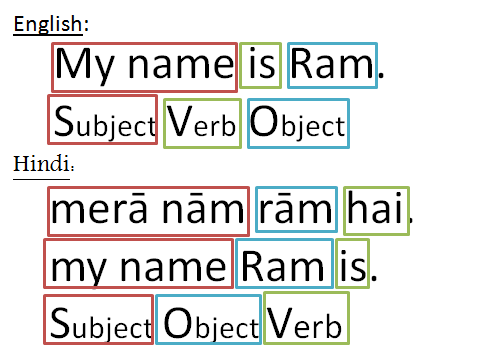
The basic word order in Hindi is Subject - Object - Verb (S-O-V) .However, since Hindi
uses more inflections and cases than English, word order is somewhat less important in
Hindi. Lets consider the sentence, I am Pankaj. This English word order is S-V-O. For
Hindi we will change it to S-O-V.
Subject - Object - Verb (S-O-V) म‹ प2कजो कि निम्न है :-


domingo, 13 de diciembre de 2015

India भारत


India is one of the oldest civilizations in the world, spanning a period of more than 4000 years, and witnessing the fusion of several customs and traditions, which are reflective of the rich culture and heritage of the Country.

The history of the nation gives a glimpse into the magnanimity of its evolution - from a Country reeling under colonialism, to one of the leading economies in the global scenario within a span of fifty years. More than anything, the nationalistic fervour of the people is the contributing force behind the culmination of such a development. This transformation of the nation instills a sense of national pride in the heart of every Indian within the Country and abroad, and this section is a modest attempt at keeping its flame alive.

India's history and culture is dynamic, spanning back to the beginning of human civilization. It begins with a mysterious culture along the Indus River and in farming communities in the southern lands of India. The history of India is punctuated by constant integration of migrating people with the diverse cultures that surround India. Available evidence suggests that the use of iron, copper and other metals was widely prevalent in the Indian sub-continent at a fairly early period, which is indicative of the progress that this part of the world had made. By the end of the fourth millennium BC, India had emerged as a region of highly developed civilization.

Devanagari final part


  • Semi vowels
य y as in yet and यहाँ yahaaṅ (here)
र r as in रुपया rupyaa (rupee)
ल l as in lean and लंबा lambaa (large, tall)
व v as in वहाँ vahaaṅ (there)
ह h as in हैं hain.

Note: Nasalised vowel
Many hindi words have nasalised vowels -sounded by restricting the air flow through the mouth
and sending it though the nose instead. This nasalisation is shown in the script as either:ँ
कँ, काँ, कुँ, कूँ
or just a dot for vowels extending above the line
किं, कीं, कें, कैं,कों, कौं  (vowel o ओ, vowel au औ when it is written अ part is removed)

  • Specials
श as in shoot and शुरू shuru (start, beginning)
ष ṣ as in भाषा bhaaṣaa (language)
स s as in सुबह subah (morning)
ज़ z as in बाज़ार baazaar  (market)
फ़ f as in flower and सफ़ाई safaai (clean)
  • Rules
case R 

R र + C च = र्च
R र + M म = र्म
R र + S = र्स
R र + K = र्क

C च + R र = च्र
P प + R र = प्र
T त + R र = त्र

R र
R र + U उ =रु
R र  + oo ऊ = रू

ट + र = ट्र
ठ + र = ठ्र
ण + र = ण्र
ढ + र = ढ्र
ड + र = ड्र


Devanagari part 2


  • Retroflex consonants


ट  ṭ as in tick and टमाटर ṭamaaar (tomatoe) 
ठ ṭh as in lighthouse and ठंड ha (cold)
ड ḍ as in doom and डाक्टर ḍaakar (doctor)

Here we have a conjunct k+t (क + ट) = क्ट. It always happens when we join consonants, another example is 'नमस्ते namaste' in which s+t (स + त)= स्त.

ढ ḍh as in mudhut and ढाबा ḍhaabaa (roadside café)
ण ṇ as in अंडा aḍaa (egg)

  • Dental consonants
त t as in ताज महल Taaj Mahalथ th as in थाली thaalee (platter)द d as in दिल्ली Dillee (Delhi)
ध dh as in धूप dhoop (sunshine)न n as in नमस्ते namaste (hello, goodbye)

conjunct st स्त

  • Labial consonants
प p as in spin and पैसा paisaa (money) 

ऐ is 'ai' when it is within  a word turns into ै above consonant, e.g. प + ऐ = पै pai, 
क + ऐ= कै kai.
फ ph as in uphill and फूल phool (flower)
ब b as in be and बाज़ार baazaar  (market)
भ bh as in abhor and भारत Bhaarat (India)
म m as in market and मेला melaa (festival, fair)

vowel ए (e) turns into े above consonant when it is written, e.g. 
म+ए = मे (words with me: mera, meri, mere = मेरा, मेरी, मेरे.

Devanagari (देवनागरी)


Devanagari consonants don’t have special name (like in English ‘ei’ for ‘a’ etc.) but are known simply by the sounds they represent followed by the vowel ‘a’. e.g. ‘ta’ ‘na’. There are seven levels in which consonants are divided, I will give you those levels in this blog and we’ll observe how vowels interact with consonants.

  
vowels
Consonants

  • Velar consonants
           क: k as in skip and kamraa ‘कमरा (room)

As we have seen previously, ‘a’ is ‘अ’ but this sound isn’t written so we assumed there’s an ‘a’ in words unless it is written at the beginning of a word. On the other hand, ‘aa’ is ‘आ’ but in this case it is written with ा symbol in words, unless there’s an ‘aa’ at the beginning as ‘aap आप. Let’s see: ‘kamraa’ has an ‘a’ and ‘aa’ sound: कमरा, the first ‘a’ isn’t written so we assume and pronounce short sound for a; whilst at the end there´s ‘aa’ sound and आ turns into ा.

           ख: kh as in sinkhole and khaanaa ‘खाना (food, to eat)

           ग: g as in go and guru ‘गुरु (teacher)

In the case of ‘u’ and ‘oo’ sounds there’s another rule.
: u : oo’ but when we write these sounds turn into ‘ु and ू‘ as in गुरु guru. And as you can see, when we write r (र) + u (ु) it turns into रु.. letter R has an specific rule we will see later on.

          घ: gh as in doghouse ghar ‘घर (home)

          ङ: ṅ as in sing gaṅgaa ‘गंगा (Ganges river)

Here, letter turns into a dot above the line, it usually happens with nasal consonants: n, ṅ, ņ, ñ, m. If one of the nasal consonants forms the first part of a conjunct it is normally replaced by a dot.  
गंगा
ñ पंजाब Punjab
 ṇ अंडा (egg)
n हिंदी or हिन्दी (Hindi, both are correct)
m लंबा or लम्बा (lambaa- long, tall. both are correct)

  • Palatal consonants

च ca as in church and चम्मच cammc (pronounce ‘chamach’ means spon)

चम्मच after च and म्म is a short sound of ‘a’ as I explained in the first level.

छ chh as in pinchhit and छुट्टी chhuttee (holiday)

ु is u not ‘oo’. ट is letter t so tt is ट्ट. About vowel ‘I’ we know is and ‘ee’ is so when these sound are within a word turn into  ‘ि’ and ‘ी’ respectively as in हिन्दी hindi (even though we know it is ‘ee’ at the end, in roman letters is writen with ‘I’ not ‘ee’)

ज j as in jump and जनवरी janvree (pronounce ‘janvaree’ means January)

झ jh as in dodge, her and झूठ jhooth (lie)

ञ ñ as in पंजाब Punjab